Go back to JSRRweb homepage:ホームページへ戻る
Prasert SONGMUANG1*, Jun Abe2 and Shigenori Morita2
Introduction
Organic materials such as compost and manure are expected as a low-input nutrient-source for crops and a material to improve the properties of farm soil. Long-term experiments on the application of rice straw compost to paddy rice have been conducted at several sites in Thailand since 1976. In this paper, these long-term experiments will be briefly summarized and results of surveys on root system morphology will be reported.
Design of the Long-term Experiments
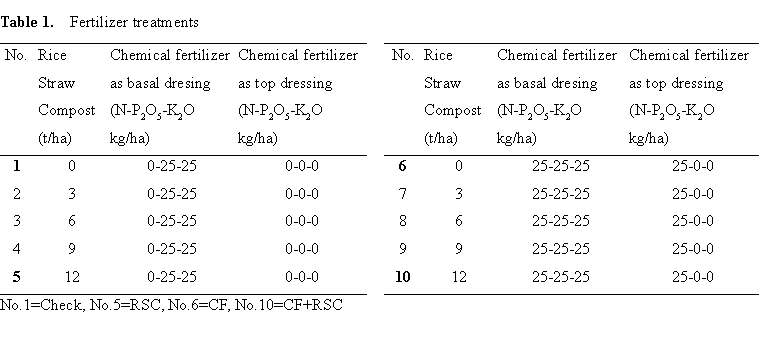
Improved modern rice cultivar, RD7, was grown in experimental fields of Rice Experimental Stations of Department of Agriculture (DOA) in Thailand. Rice straw compost and chemical fertilizers (e.g., ammonium sulfate as nitrogen-source) were applied as indicated in Table 1. Three replications were set for each fertilizer treatment. In this paper, mostly four typical treatments are mentioned as check (no. 1 in Table 1), rice straw compost treatment (RSC: no. 5), chemical fertilizer treatment (CF: no. 6), and combined treatment of rice straw compost and chemical fertilizer (CF+RSC: no. 10).
Effects of Compost on Shoot Growth and Yielding of Rice
Application of rice straw compost, as well as chemical fertilizer, promoted shoot growth (e.g., number of tillers, LAI) and increased grain yield remarkably, though the details were varied with locations and years. The increase of grain yield was linearly correlated with the amount of applied compost (Songmuang et al., 1985). Grain yield was often higher in RCS than CF in Surin Rice Experimental Station, where large run-off of nitrogen occurs due to the sandy property of the soil (Vacharotayan and Takai, 1983). These results indicate the availability of rice straw compost as a slow-release nitrogen source for paddy rice.
Effects of Compost on Root System Morphology
Root system morphology were studied at panicle-initiation and harvesting
stages in Ratchaburi Rice Experimental Station in 1987, and at harvesting
stages in Surin Rice Experimental Stations in 1996. Soil in Ratchaburi
is a gley soil with a clay loam texture, whereas soil in Surin is a humic
gley soil with a sandy loam texture (Kawaguchi and Kyuma, 1969). Nodal
roots were classified into two categories and counted: one is 'elongated
root' that is more than 5cm long, and the other is 'stunted root' that
is less than 5cm long (Yamazaki and Harada, 1982). Growth angle of nodal
roots to horizontal was estimated using cylindrical-monolith method (Morita
et al., 1988).
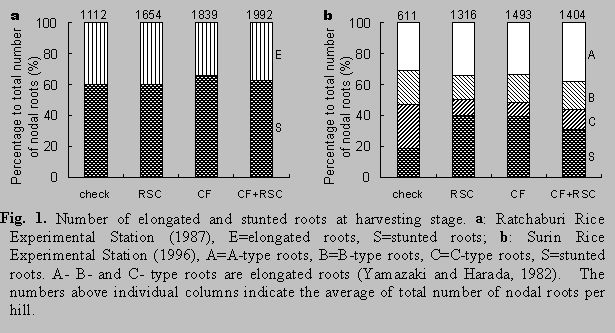
In the study conducted in Ratchaburi Rice Experimental Station, the ratio
of elongated roots to stunted roots was higher in RSC than in CF (Fig.1a).
Moreover, percentage of nodal roots with small growth angle (<30o) to
horizontal was large in CF. These results are coincide to the report (Kawata
and Soejima, 1976) that larger number of roots were observed in deep soil
layer in compost-applied paddy field than in chemical fertilizer-applied
one in a northern part of Japan. Such effects of compost application on
root system morphology might be explained by the slow release of nitrogen
from compost and by change of soil physical properties. On the other hand,
however, no difference was shown between RSC and CF in either ratio of
elongated roots nor growth direction of nodal roots in the study conducted
in Surin Rice Experimental Station (Fig.1b). It
seems that the effects of rice straw compost may vary depending on the
locations, relating to the soil properties and differences in shoot growth.
References