Go back to JSRRweb homepage:ホームページへ戻る
The Characters of Rice Root in Gleyed Paddy
Soils and Their Improvement
by Ridge Cultivation
Li Y. Z. and Y. M. Huang
Rice & Wheat Research Institute of Fujian Academy of Agricultural
Sciences,
Fuzhou, China, 350007
Introduction
There is about 166,700 hm2 of gleyed paddy soils in the mountain area of Fujian province, which constitutes about 30% of the total rice producing soils in the area. The gleyed paddy soils in Fujian are mainly distributed in mountain valleys. For year-long irrigation, submergence by cold spring water, the soils are cold, structureless and anaerobic. The rice root growth is inhibited and grain yields are low. The gleyed paddy soil improvement techniques of ridge cultivation have been applied throughout the Fujian province. The great results have been got. At the same time, the characters of rice root growth in gleyed paddy soils and improvement effect have been observed.
Research method
The root dry weight of different layer were measured from shallow gleyed paddy soils, deep gleyed paddy soils and sandy loam paddy soils in 1985 with improvement Momolith method. In 1987and 1988, the comparison experiment of ridge cultivation and tradition cultivation with plots area 13.3m2, three repetitions, and the hybrid rice (F1) is used. At the different rice growth stage, the Eh, the a-NA oxidizing capacity of root, the 32P absorbed by root and the bleeding intensity were measured. At the late milk ripe stage, the root volume and dry weight of vary layers were measured with improvement MONOLITH method.
Research Results
Morphological development of root in Gleyed paddy soil
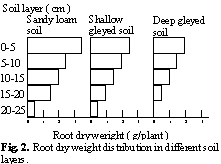
In the shallow and deep Gleyed paddy soils and sandy paddy soil, the root volume and dry weight distributed in top soil layer showed higher than that in lower. At late milk ripe sage, the root dry weight distributed in the 0-5 cm soil layer amounted to 42-46% of the total dry root weight, in the 5-10 cm to 25-31%, in the 10-15 cm to 16-18%, in the 15-20 cm to 7-13% and in the 20-25 cm to 1-2%. The development of root in Gleyed paddy soil was inhibited. The root dry weight of shallow Gleyed paddy soil and deep Gleyed paddy soil was only 63% and 42% of that in the sandy loam soil respectively. With the deepening layer, the root dry weight decreased greatly. For the unhealthy morphological development of roots in the gleyed paddy soil, the rice plant growth was inhibited at the early stage, the stems and leaves decline early at the later stage and resulting in low grain yield.
Ridge-bed cultivation and its effect for gleyed paddy soil
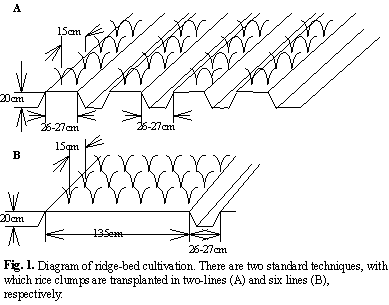
An effective way of improving physical and chemical characteristics
of the gleyed paddy soil is to apply the ridge cultivation technique. In
ridge cultivation field, fifteen days after transplantation, the field
is irrigated with a shallow depth of water; during tillering, irrigation
water is applied to keep the ridge 10 cm above the water; at the end of
tillering, the water is drained; from then on, intermitted half-ditch irrigation
is applied to keep the ridge-bed in a moist condition. After that, the
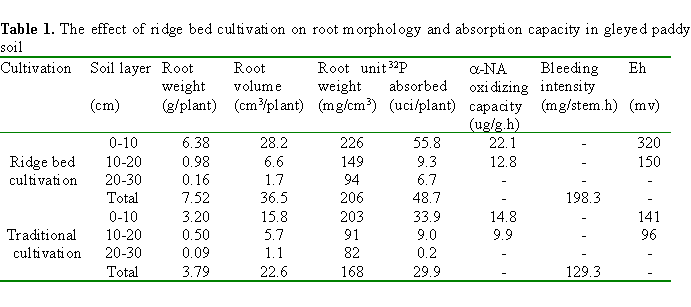
high anaerobe condition was improved, which promoted root growth. According
to measurement conducted in Wuyishan city at the late milk ripe stage (Table
1 ), the anaerobe matter contented in ridge cultivation field soil
was 28.6% lower then that in tradition cultivation field soil; The Eh increased
98.3% ; The root dry weight increased 98.4%; The root volume increased
61.5%; The root weight/volume increased 22.6%; The a
-NA oxidizing capacity of root increased 62.9%; The 32P
absorbed by root increased 41.3% and the bleeding intensity increased 53.4%
especially. Among which, that of in 0-10 cm soil layer increased much significantly.
For the effect drainage and promoting root growth of ridge cultivation,
the grain yield from ridge cultivation increased greatly. According to
the Agricultural Bureau, the ridge-bed cultivation technique was applied
in 323 thousand ha in Fujian province from 1987-1989. A good result of
improving soil and increasing yielding have been got. From the results
in a comparative experiment at 21 locations, the average grain yield from
the ridge cultivation was 655 kg/hm2, 22.3% higher than that from traditional
cultivation.
References