Go back to JSRRweb homepage:ホームページへ戻る
Craig Beyrouty1*, Yan Hock Teo1, Jason Pulley1, and Edward Gbur2
Introduction
We have conducted several studies to identify factors affecting nutrient
uptake by paddy rice. In these studies, we evaluated a mechanistic model
that satisfactorily predicts N, P, and K uptake by rice during vegetative
growth under greenhouse and field situations. The model assumes that nutrient
movement to a plant root is controlled by mass flow and diffusion and that
uptake is active and follows Michaelis-Menten kinetics. Active uptake requires
that the plant must expend metabolic energy to absorb certain nutrients.
This type of uptake is in contrast to passive uptake which does not require
expenditure of metabolic energy by the plant.
The model is used to assess the influence of each of 11 soil and plant
parameters on nutrient uptake (sensitivity analysis). We have found that
N and P uptake are most influenced by the rate of root growth and the solution
concentration of these two nutrients. Potassium uptake, on the other hand,
is most influenced by the kinetic parameter, Imax,
which is the maximum influx rate of K into roots at high soil solution
K concentration.
Potassium deficiencies are becoming more frequent in paddy rice fields
in Arkansas. With the knowledge that K uptake is influenced by Imax, we
have focused our attention on the influence of cultivar and environment
on this kinetic uptake parameter to provide possible explanations for K
deficiencies in the field. Studies that we have conducted, although limited,
have shown that rice plants differ in the maximum rates of K uptake. However,
we have not related values of Imax to the ability of a plant to compete
for K under field conditions. Plants that have high Imax values for K may
deplete soil solutions of K quickly if the soil buffering capacity is low
and thus, may be more susceptible to K deficiencies.
Salinity is also a problem on many of our paddy rice soils in Arkansas
and rice producers limit K fertilizer application to these soils to reduce
the possibility of enhancing salinity damage to the rice plant. We were
interested in evaluating the effect of salt type and salt concentration
on the Imax values for K uptake to develop
K fertilization strategies for these salt affected soils.
A series of studies were initiated to quantify the maximum rates of K uptake
by several rice cultivars and to compare these values with visual observations
of K deficiency symptoms. If a relationship exists, cultivars can be selected
by producers that respond better to soils that test low in plant available
K. We also investigated the influence of salt on K uptake by rice.
Cultivar Differences in Imax
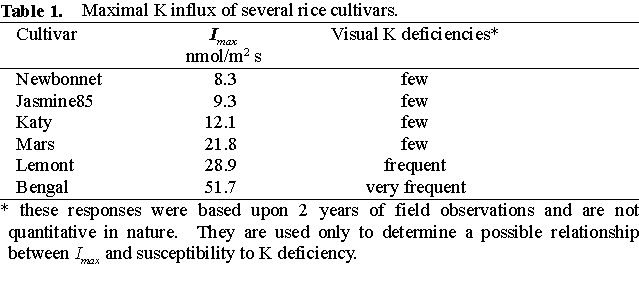
Table 1 shows the Imax
measured for each of six rice cultivars. Bengal had the highest Imax
for K, followed by Lemont and Mars. This suggests that under similar concentrations
of soil solution K, Bengal has the capacity to absorb K at a faster rate
than the other rice cultivars. Under situations of low plant available
K concentrations or where soil buffering of K is low, Bengal may exhaust
limited supplies of K quicker than other cultivars.
Visual deficiency symptoms of K in field-grown paddy rice have been most
widespread with Bengal. Lemont has exhibited fewer instances of K deficiencies
in the field, while the remaining cultivars evaluated in this study rarely
exhibit K deficiencies in the field. Although preliminary in nature, this
information suggests a relationship between the rate at which a cultivar
absorbs K and the susceptibility of that cultivar to K deficiencies. If
this relationship is found to be consistent among all cultivars, it may
help explain differences in visual deficiency symptoms for K under field
conditions. A knowledge of the potential susceptibility to K deficiency
will be a valuable tool for selection of appropriate cultivars to grow
on soils that are low in plant available K.
Salt affects K uptake kinetics
We subjected a salt sensitive and salt tolerant rice cultivar grown
in nutrient solution to different rates and combinations of NaCl and CaCl2
salts for 58 days. This was followed by a K depletion study in which values
of Imax for K were calculated for each cultivar-salt
treatment combination.
Depletion of K could not be described by Michaelis-Menten for the salt-tolerant
cultivar subjected to high concentration of NaCl and for the salt-sensitive
cultivar subjected to high concentration of all salts and low concentration
of NaCl. Addition of CaCl2 to the salt-tolerant cultivar
increased Imax by 81% over the zero salt control.
Values of Imax for both cultivars, where K uptake followed Michaelis-Menten,
were not different from the zero salt control. Thus, Na appeared to either
reduce or have little negative effect on K uptake. With the salt-tolerant
cultivar, Ca actually stimulated the ability of the rice plant to absorb
K.